A two-party NDA is easy. One sender, one signer, done by lunch.
The documents that actually stall Indian businesses are the multi-party ones: a vendor agreement signed by your director, the vendor’s proprietor, and a witness. A franchise agreement with four signatories across two cities. A partnership deed with five partners, one of whom is perpetually travelling.
On paper, these documents move at the speed of the slowest courier. Print four copies, sign in Ahmedabad, courier to Mumbai, discover page 7 was missed, courier again. Three weeks is normal. A month is common. And every day the agreement sits unsigned, the actual work it governs sits unstarted.
Why multi-party is where paper hurts most
The cost of a paper signature isn’t the ink — it’s the round trips. With two parties there’s one round trip. With five parties signing in sequence, there are four handoffs, each an opportunity for delay, loss, or a missed page. The pain compounds:
- Sequential dependencies. Partner 3 can’t sign until Partner 2 has, so one busy person stalls everyone downstream.
- Version confusion. Which of the three couriered copies is the master? Did everyone sign the same draft?
- The missed-page problem. One unsigned page on one copy, discovered late, restarts the loop.
Electronic signing removes the round trips entirely. Every signer gets the same document, signs from their own phone or laptop, and the sequence advances automatically the moment each signature lands.
How a multi-party signing flow actually works
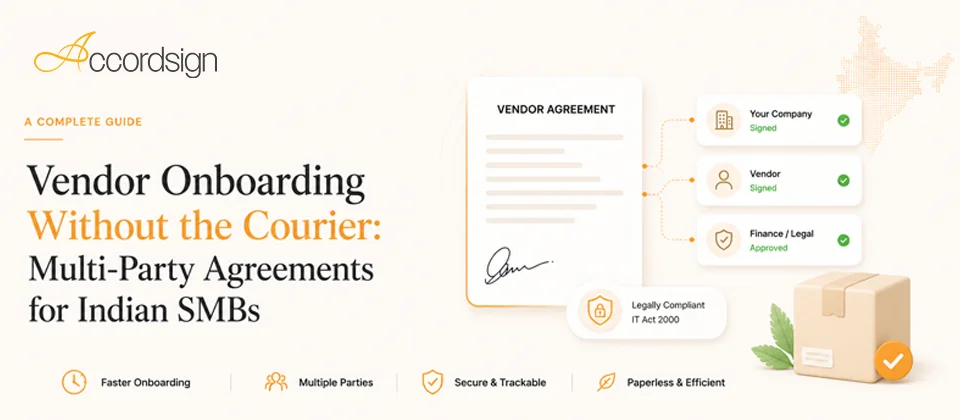
Take a vendor agreement with three signatories: your authorised director, the vendor’s proprietor, and a witness.
- Upload the agreement once. One master document. No copies, no versions.
- Add the signers and choose the order. Sequential if the witness should sign last; parallel if order doesn’t matter. Each signer gets their own signature fields.
- Choose the signature type per signer. For agreements where identity assurance matters, each party signs with Aadhaar eSign — each signer authenticates with their own Aadhaar OTP, and each signature carries its own certificate. For lower-stakes internal sign-offs, standard electronic signatures work.
- Send. Each signer receives the link when it’s their turn. If someone sits on it, automatic reminders nudge them — you don’t have to chase.
- Everyone gets the completed document. One final PDF carrying every signature and a full audit trail: who signed, when, in what order, authenticated how.
What took three weeks of couriers takes a day — usually less, because the thing that actually consumed the three weeks was never the signing. It was the logistics.
Worth separating out a case that sounds similar but isn’t: several people signing one document is multi-party signing, which is what this post is about. Sending the same document to many people so each gets their own individual copy — a policy acknowledgement to every employee, a consent form to every parent — is a different job, and that’s Bulk Send, available on Business plans.
Multi-signer Aadhaar eSign, specifically
A note on the Aadhaar case, because it matters for agreements where you want strong identity binding on every party: each signer completes their own Aadhaar OTP authentication, and each receives their own one-time signature certificate on the document. The vendor’s proprietor in Surat and your director in Ahmedabad each sign with their own identity — no shared logins, no “sign on behalf of.” For vendor onboarding, franchise agreements, and partnership deeds, this is the difference between “someone clicked a button” and “these specific people signed.”
What multi-party signing costs — and the pricing trap to watch for
Here’s the part worth doing arithmetic on before you choose a platform.
Some eSignature providers in India price per signatory. That sounds harmless until you notice your documents have more than one. At a per-signatory rate, a 4-party agreement costs 4× a single signature. A business doing twenty multi-party agreements a month is paying for eighty signatures.
Accordsign prices per document. A document is a document whether one person signs it or five. Your 4-party vendor agreement consumes exactly one document from your plan — the same as an NDA.
One clarification, so the arithmetic is honest: Aadhaar eSign credits are billed separately, on a per-signature basis. A four-party agreement signed with Aadhaar uses one document from your plan, plus four Aadhaar credits. Current rates for both are on our pricing page.
For a business whose core paperwork is multi-party — vendor onboarding, franchising, partnerships, co-founder agreements — this isn’t a rounding difference. Run your own numbers: count your average signers per document, and compare per-signatory pricing against per-document pricing at your monthly volume. For multi-party-heavy businesses, the gap is usually the whole decision.
A realistic vendor-onboarding flow
Putting it together, here’s what onboarding a new vendor looks like when the paperwork is electronic end to end:
- Vendor agreement sent for signature — director, proprietor, witness — signed same day.
- NDA alongside it, signed in parallel.
- Both completed documents land in everyone’s inbox with audit trails attached.
- The purchase orders start moving — which was the point all along.
The agreement was never the goal. The work it unlocks is. Every day saved on signing is a day the actual business relationship starts sooner.
Where paper still wins (honesty section)
A few document types in India still legally require traditional execution — registered sale deeds for immovable property being the prominent one, along with the other Schedule I exclusions under the IT Act. If your vendor relationship involves registering a lease or conveyance, that specific document still goes the physical route. Everything around it — the service agreement, the NDA, the SLA — doesn’t.