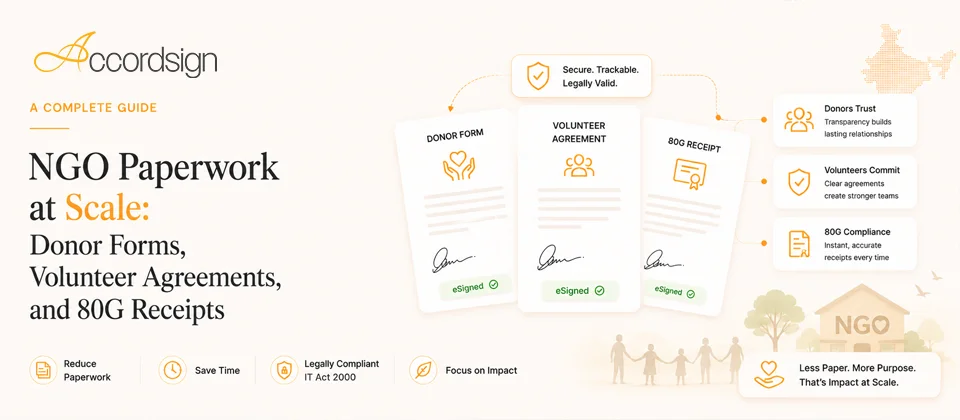
Nobody joins an NGO to do paperwork. Yet a mid-sized Indian nonprofit generates a startling amount of it: donor documentation, 80G receipts every giving season, volunteer agreements for every batch of new volunteers, consent forms for programme participants, MoUs with partner organisations, board resolutions for every governance decision.
Most of this still moves on paper, and it moves slowly — because NGO teams are small, often part-time, and the person who handles documentation is usually also the person running three programmes. This post is a practical look at which of that paperwork can go digital, and what changes when it does.
The volunteer agreement problem
Start with the highest-volume case. Every volunteer intake — and active NGOs run them monthly — means a stack of agreements: code of conduct, liability waiver, sometimes a background-check consent. On paper, this is a table at orientation with pens and a scanning backlog. Predictably, some agreements go missing, some are illegible, and the file for last year’s volunteers lives in a cupboard.
Electronically: the agreement goes out when a volunteer is accepted, they sign from their phone before orientation day, and every signed agreement is stored, searchable, and attached to a name. When a compliance question arrives two years later — and with foreign-funded NGOs especially, it does — the document is a search away, not a cupboard excavation.
For most volunteer paperwork, a standard electronic signature is entirely sufficient. The document’s job is record-keeping, not high-stakes identity proof.
When the intake is a batch rather than a trickle, Bulk Send is the shape that fits: the same agreement goes out to up to 500 people at once, personalized to each from your list, with every volunteer receiving their own private copy rather than a shared document or a group thread. Same for consent forms across a programme cohort. It’s available on Business plans.
Where identity actually matters: Aadhaar-verified signing
Some NGO documents carry more weight, and for those, who signed matters as much as that someone signed:
- MoUs with partner organisations and government bodies — signed by authorised signatories on both sides.
- Board resolutions and governance documents — where the signature of a specific trustee or director is the point.
- High-value donor commitments — pledge agreements, CSR partnership documents.
For these, Aadhaar eSign adds identity binding: each signatory authenticates with their own Aadhaar OTP, and the document carries a certificate in their name, valid under the IT Act. A board resolution signed this way doesn’t depend on anyone recognising a scrawl — the identity is in the cryptography. And because these documents are often multi-party (three trustees, two organisations), electronic signing also removes the courier loop that makes a five-signature resolution take a month.
The 80G receipt question
Every donation an 80G-registered NGO receives obligates a receipt the donor will use for their tax deduction. At scale — a giving-season campaign, a payroll-giving programme — this becomes thousands of documents, each of which should be issued promptly, consistently, and in a form the donor can rely on.
Digitally issued receipts solve the throughput problem. The forward-looking version of this — receipts that are themselves digitally certified, so a donor (or an assessing officer) can verify authenticity rather than trusting a PDF that anyone could have typed — is where document infrastructure for the nonprofit sector is heading. If your NGO issues receipts at volume and the process today involves someone’s signature being pasted as an image into a template, it’s worth treating that as a solved problem rather than a permanent chore.
What this changes operationally (the honest version)
The pitch for going digital is usually “save time,” but for NGOs the deeper wins are different:
Auditability. NGOs live under scrutiny — FCRA compliance, 80G renewals, donor due diligence. Digital signing produces an automatic audit trail for every document: sent when, signed when, by whom. When an auditor asks for the volunteer agreements from March 2025, that’s a filter, not an afternoon.
Continuity. NGO teams rotate. The documentation knowledge that lives in one coordinator’s head — and one cupboard — survives their departure when documents live in a system instead.
Donor confidence. Professional, promptly-issued, verifiable documentation reads as organisational competence. Donors notice.
Cost discipline. Printing, couriering, and storing paper is a real line item for a small organisation. So is the staff time. Nonprofits justify every rupee; this is one of the easier reallocations to defend.
Where to start
Don’t digitise everything at once. The sequence that works:
- Volunteer agreements first — highest volume, lowest stakes, immediate relief.
- Partner MoUs and board resolutions next — lower volume, higher value, where Aadhaar-verified multi-party signing earns its keep.
- Donor documentation at scale last — receipts and pledge forms, once the team is comfortable with the tooling.
One practical note: eSignature platforms with per-document pricing (rather than per-signatory) suit NGO economics better, since governance documents tend to carry many signatures. And trial tiers let a small team validate the workflow on one volunteer batch before committing budget — which is exactly how a resource-careful organisation should evaluate any tool.
Paperwork will never be why anyone joined your organisation. It can at least stop being the thing that slows the mission down.