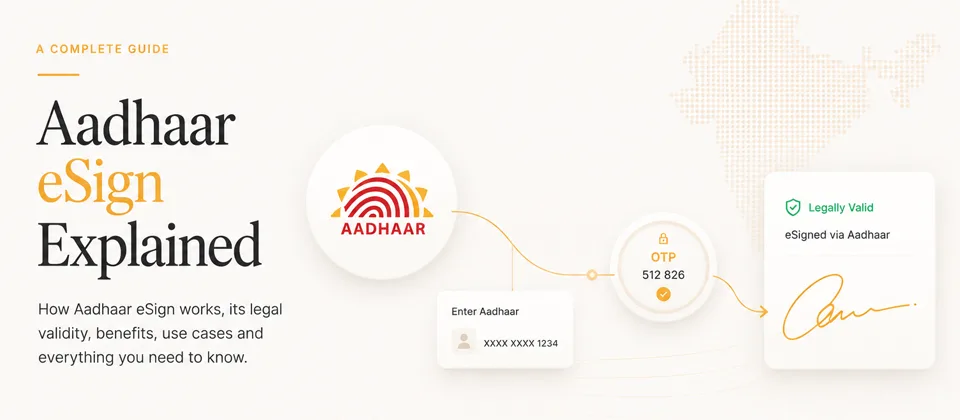
Aadhaar eSign is the government-of-India mechanism that lets any of the country’s 1.4 billion Aadhaar holders place a legally valid digital signature on a document, using just their Aadhaar number and a one-time password sent to their Aadhaar-linked mobile.
It’s not a scanned signature. It’s not a DSC token. And — for most contracts — it’s the cheapest path to a signature that holds up in an Indian court.
What Aadhaar eSign actually is
Aadhaar eSign is a signing technique recognised under Section 3A of the Information Technology Act 2000. The cryptographic part — the actual signature — is performed by a CCA-licensed eSign Service Provider, one of a handful of entities authorised by the Controller of Certifying Authorities to issue digital signatures based on Aadhaar eKYC.
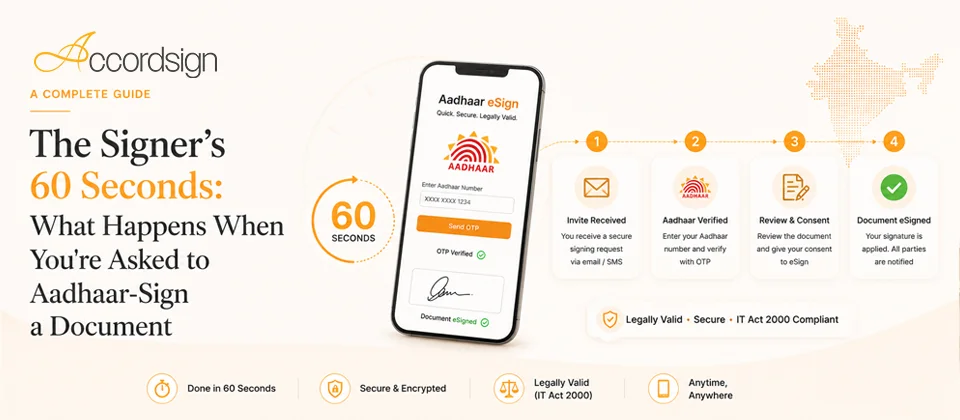
When you sign a document using Aadhaar eSign, three things happen behind the scenes:
- You confirm your Aadhaar number on the signing form.
- UIDAI sends an OTP to your Aadhaar-linked mobile.
- The licensed ESP uses that OTP authentication to issue a one-time Digital Signature Certificate and applies it to the document.
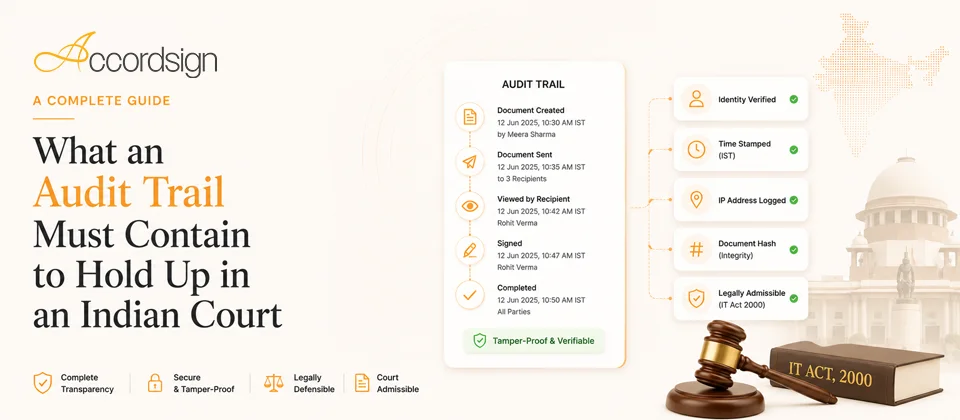
The signed PDF you receive is cryptographically tied to your Aadhaar identity. The audit trail records the OTP exchange, the timestamp, your IP address, and the ESP that performed the signing.
How it differs from the alternatives
| Approach | What it is | Legal status | Cost |
|---|---|---|---|
| Scanned signature | A picture of your handwritten signature pasted onto a PDF | Weak — easy to fake, no audit trail | Free, but legally unsound |
| Wet signature | Ink on paper | Strong — universally recognised | Cost of printing + courier |
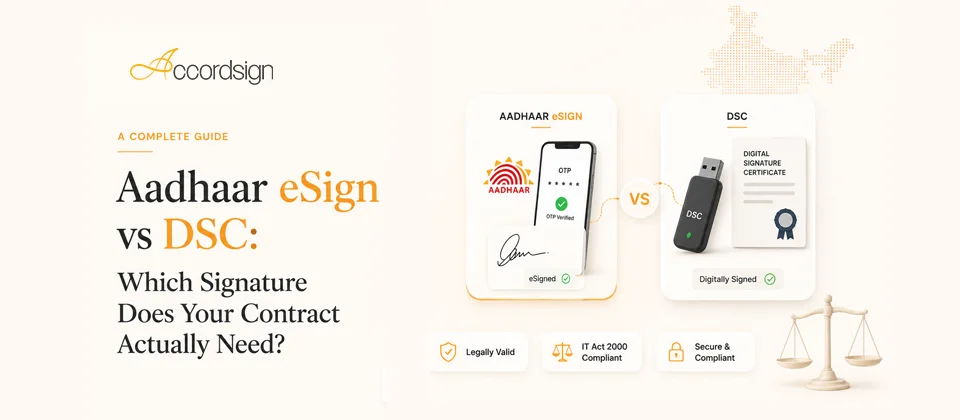
| Aadhaar eSign | OTP-authenticated digital signature via licensed ESP | Strong — IT Act §3A, admissible under BSA 2023 §63 | ₹20–75 per signature |
| DSC token | USB hardware token with a stored certificate | Strongest — required for GST, MCA, customs | ₹1,500–3,000 one-time + annual |
For most business contracts — NDAs, SOWs, employment letters, vendor agreements — Aadhaar eSign hits the sweet spot. Cheaper than a DSC, stronger than a scanned signature, no paper trail to ship.
What you can sign
Aadhaar eSign is legally valid for the vast majority of Indian business contracts:
- HR documents — offer letters, NDAs, employment contracts, onboarding paperwork
- Sales — service agreements, vendor contracts, MSAs, SOWs
- Finance — loan agreements, KYC forms, account opening
- Commercial — rental agreements (with appropriate stamp paper), partnership deeds
What you cannot sign
There’s a short list of document types Indian law excludes from electronic signing — Aadhaar eSign included:
- Wills and testamentary documents
- Negotiable instruments (cheques, promissory notes) — except for specifically regulated cases
- Powers of attorney for property registration
- Real-estate sale deeds (state-law dependent)
- Trust deeds in most states
When in doubt, consult a lawyer. Aadhaar eSign covers most contracts in India, but a small set of document types is excluded by statute, and the list above isn’t exhaustive.
What it costs
The per-signature cost varies by platform — most charge anywhere from ₹25 to ₹75 per Aadhaar signature. The cost reflects the price the platform pays to its licensed ESP plus margin.
Accordsign charges ₹20 per Aadhaar signature, flat. No volume tiers, no minimums. We chose to compete on price rather than margin.
When NOT to use Aadhaar eSign
Three cases:
-
Statutory filings — GST returns, MCA submissions, customs declarations, IT department uploads. These specifically require a DSC token. Aadhaar eSign won’t be accepted.
-
Documents the law excludes — see the list above. Wills, sale deeds, certain POAs.
-
Signers without Aadhaar — NRIs without Aadhaar, non-Indian counterparties. For these, use a standard electronic signature (still valid under IT Act 2000) without the Aadhaar layer.
The compliance picture
Aadhaar-signed records are admissible as evidence in Indian courts under Bharatiya Sakshya Adhiniyam 2023 Section 63 (formerly Section 65B of the Indian Evidence Act), when accompanied by their audit trail. The ESP, not the application platform, issues the actual signature — which means the cryptographic trust anchor sits at a CCA-licensed entity, not at a SaaS company.
That distinction matters more than it sounds. It means the signature’s legal validity doesn’t depend on the long-term viability of any particular signing platform.
Bottom line
If you’re signing business contracts in India and your signer has an Aadhaar with an active mobile linkage, Aadhaar eSign is almost certainly the right tool. Cheaper than a DSC, stronger than a scan, no hardware, no paperwork.
For everything else — statutory filings, excluded document types, signers without Aadhaar — fall back to the appropriate alternative.