Most eSignature comparisons are written by the people selling one. This one is too — we make Accordsign — so read it with that in mind. What we’ve tried to do here is write the guide we’d want if we were buying: the questions that actually matter, the trade-offs nobody puts on their pricing page, and an honest word about where each option, including ours, is genuinely the wrong choice.
If you take nothing else away, take this: the right eSignature platform depends far more on how your business signs than on any feature list. A ten-person consultancy sending four NDAs a month and a lender pushing thousands of loan agreements have almost nothing in common as buyers, and a tool that’s perfect for one is an expensive mistake for the other.
Start with your actual signing profile
Before you look at a single vendor, answer three questions about yourself.
How many documents, and how often? Occasional and bursty (a handful of contracts a month, clustered around deals) points you toward pay-as-you-go pricing. Steady and high-volume (onboarding, lending, insurance) makes a subscription or a volume contract worth it. Guessing wrong here is the single most common way businesses overpay.
Who are your signers? If they’re Indian, Aadhaar eSign will be the fastest legally valid path and you should insist on it. If they’re global — overseas customers, NRIs, foreign vendors — you need a standard electronic signature workflow that works anywhere, and Aadhaar won’t help you. Many businesses need both.
Where does the signing actually start? This is the question people skip. If your team lives in Salesforce all day and the contract is attached to an Opportunity, a signing tool that makes them leave Salesforce, re-enter the customer’s details, and come back to update the record manually will quietly cost you hours every week. If your signing starts from an email or a folder, that matters much less.
The questions worth asking every vendor
Does it support Aadhaar eSign natively? In India this is close to table stakes, and the word doing the work is natively. DocuSign documents an Aadhaar path through eMudhra, but as an integration a customer builds and configures rather than a feature switched on with a plan. Zoho Sign, being an Indian product, supports Aadhaar eSign directly. The question to ask any vendor is not whether Aadhaar is possible but whether it is included — because “possible via an integration project” and “on by default” are very different answers when your signers are Indian.
Does it do e-stamping? For many Indian contracts — lending, real estate, high-value B2B — the document needs stamp duty paid, not just a signature. Leegality and Digio both offer stamping alongside signing, in a single flow. We don’t, yet. If your contracts need stamp-plus-sign in one motion, that’s a genuine reason to look at them and not at us. We’d rather tell you that now than after you’ve signed up.
How is it priced — per document, or per signatory? This one compounds quietly and almost nobody checks it before they buy. Per-signatory pricing means a contract with four parties costs you four times as much as a contract with one. Per-document pricing doesn’t. If you routinely sign multi-party agreements, the difference over a year is not small. Ask explicitly, and do the maths on your mix, not their example.
Is the pricing published? If you have to book a call to find out what something costs, that’s information too. It usually means the price depends on what they think you’ll pay — and that the good number is the one you only get by threatening to leave.
What does the audit trail actually contain, and would it hold up? Every vendor says “audit trail.” Ask what’s in it: signer identity, action, timestamp, IP. Ask what the signed document itself carries. If your contracts are ever likely to be disputed, ask your lawyer what evidence they’d want and check the vendor produces it.
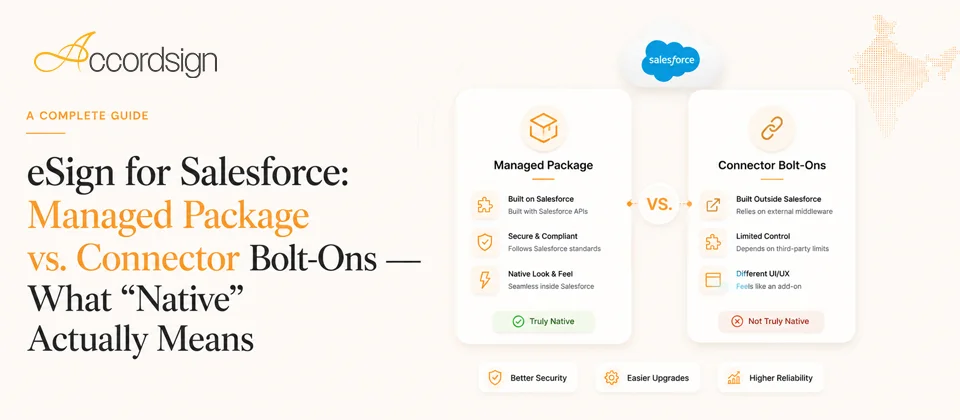
Does it live inside the system you already work in? A native integration — one that actually lives inside your CRM rather than bridging to it over an API — means the signer details come from the record, the status returns to the record, and nobody re-types anything. A connector is fine; it’s just not the same thing, and the difference shows up in the small daily frictions rather than in the demo.
Can your signers sign without creating an account? Sounds trivial. It isn’t. Every account your counterparty has to create is a place the deal stalls.
The honest landscape
DocuSign and Adobe Acrobat Sign are the global incumbents. They’re mature, they’re trusted internationally, and if you’re a large enterprise signing across many countries with a procurement team that wants a household name, they’re a defensible choice. They’re also expensive, subscription-first, and — the thing that matters most here — they don’t do Aadhaar eSign. For an India-centric SMB, you’re paying a global premium for capabilities you don’t use, and missing the one you do.
Leegality is the most established Indian player, deep in BFSI, with stamping, signing, and a broad document-infrastructure suite. If you’re a regulated lender doing high volumes with complex stamp-and-sign workflows, they are a serious and credible option. Worth noting their pricing is per-signatory, which is a very different cost curve if you sign multi-party contracts.
Digio is API-first and strong on the identity and payments rails — KYC, eSign, e-mandates, stamping. If you’re a fintech building signing into your own product, that developer-first posture is a real advantage.
Zoho Sign is a sensible pick if you’re already deep in the Zoho ecosystem, for the same reason we argue for Salesforce-native: signing should live where your work lives.
Accordsign — ours — is built for Indian SMBs and teams who want signing to be simple, honestly priced, and to work where they already work. Aadhaar eSign is built in. Pricing is published, with a pay-as-you-go option and no subscription lock-in on the Individual plan. It’s a native Salesforce managed package, not a connector. We’re the right choice if you’re a small or mid-sized business that signs regularly, wants Aadhaar, and doesn’t want to negotiate for a fair price. We’re the wrong choice if you need e-stamping today, or if you’re an enterprise that needs a global compliance footprint across many jurisdictions. That’s not modesty; it’s just true, and you’d find out anyway.
A short buyer’s checklist
Before you commit to anyone, run this:
- Does it handle Aadhaar eSign for my Indian signers?
- Does it handle non-Aadhaar signers for anyone else?
- Do I need e-stamping — and does it do that?
- Is it per-document or per-signatory, and what does that cost me at my real volume?
- Is the price published, or do I have to negotiate for it?
- Does it integrate natively with the system my team actually works in?
- Can my counterparties sign without creating an account?
- What exactly is in the audit trail?
- What happens if I want to leave — can I get my documents out easily?
That last one is worth more than it looks. A vendor’s answer to “how do I leave?” tells you how confident they are that you won’t want to.
Then just try it
Feature lists are a poor proxy for daily reality. Pick your two or three shortlisted tools, take a real contract you actually need signed this week, and send it through each one. The one that gets it signed with the least friction — for you and for the person on the other end — is almost always the right answer, whatever the comparison table said.
If you’d like to try that with us, our pricing is right there with no sales call, our free templates are yours whether you buy anything or not, and the FAQ answers most of what people ask before they start. And if this guide points you somewhere else — that’s a good outcome too. Choosing right matters more than choosing us.